Observed development
Cells die at future openings
A microscopy study documented programmed cell death in M. obliqua. This supports a developmental mechanism in that species, not a named “fenestration gene” in the two featured plants.
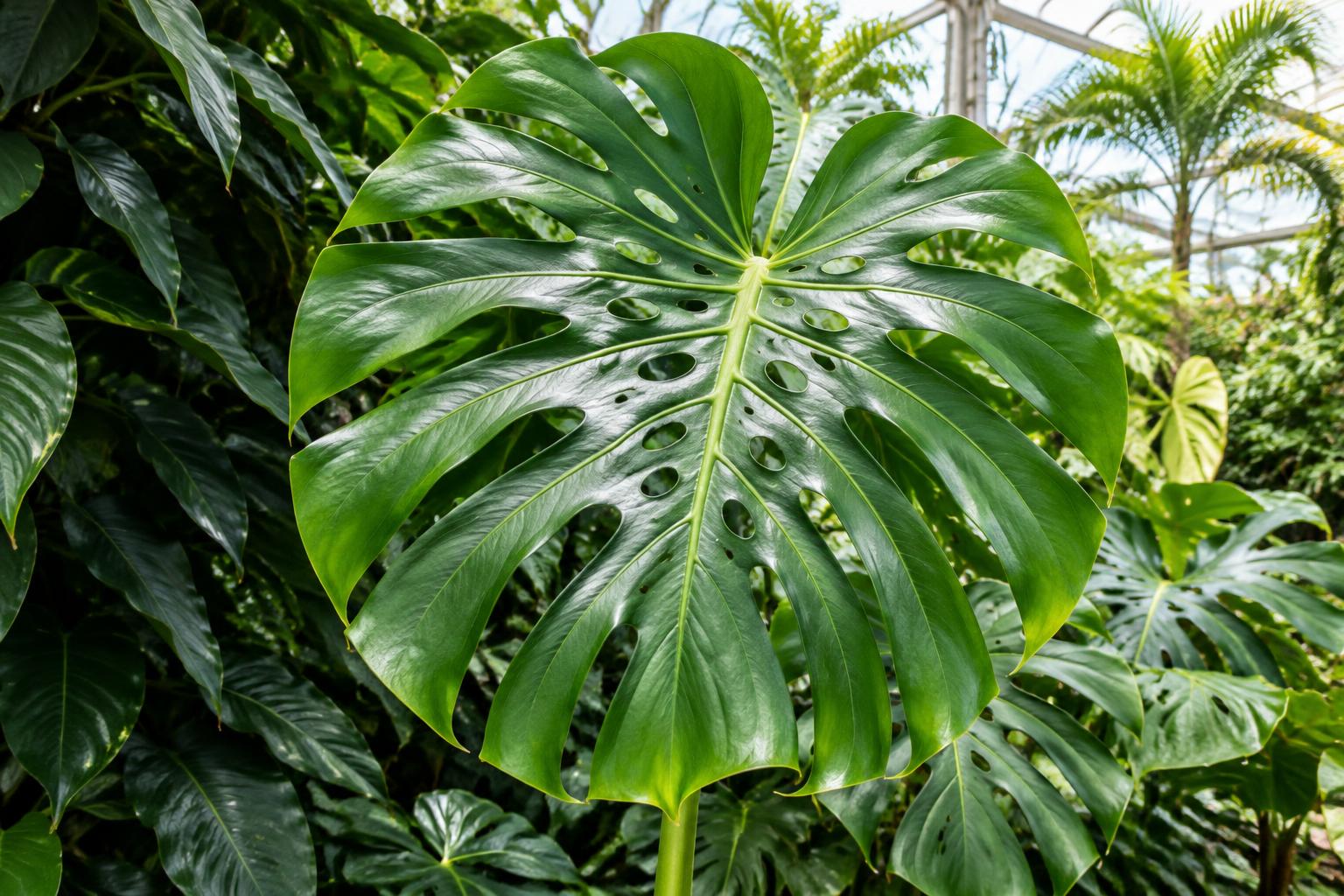
Examples in nature · 01
From molecular instructions to the holes in a leaf.
Monstera deliciosa · Monstera adansonii
Generated botanical illustration of M. deliciosa; not a research specimen.
A gene is not a hole-making blueprint on its own. The connection runs through proteins and coordinated development. This is a learning pathway—not an identified chain of Monstera fenestration genes.
General biology
Instructions are not the finished leaf.
Protein-coding genes contain instructions that cells read through RNA to build proteins. Gene regulation helps decide where and when those proteins are made.
Glossary: The spelling · Primary structureThe AlphaFold connection
Given a verified protein sequence, AlphaFold predicts a possible 3D structure. That model can help researchers form questions about the protein’s activity or interactions.
The sources below do not establish a specific causal gene or protein for fenestration in M. deliciosa or M. adansonii. Expression studies and functional experiments would be needed to test candidates. No Monstera protein prediction is presented here.
Observed development
A microscopy study documented programmed cell death in M. obliqua. This supports a developmental mechanism in that species, not a named “fenestration gene” in the two featured plants.
Functional hypothesis
A theoretical model suggests perforated leaves could reduce variation in growth under patchy light. It is a testable explanation, not proof of why the trait evolved.
Not established here
Wind resistance, drainage and weight reduction are proposed benefits. The linked evidence does not establish them as causes of Monstera fenestration. Transparent leaf windows in Lithops and Haworthia are a different trait—not holes through the leaf.
Direct cellular observations; a different Monstera species from the two pictured examples.
A theoretical test of the sunfleck hypothesis, not a demonstrated evolutionary cause.
A distinct aquatic plant; its developmental mechanism should not be assigned to Monstera.
Protein structure prediction and how to interpret a model.